













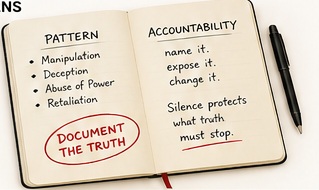
There is a special kind of courage required to look at a nineteen-year-old who has just been humiliated, violated, and failed by every adult in the room—and decide that the real problem was her judgment.
That is not justice. That is institutional housekeeping. Sweep the ugly facts under the rug, polish the legal language, and hope nobody notices the person still lying underneath it.
The case examined in this episode begins with Deborah Fogle, a young Taco Bell employee, and a caller pretending to be a police officer. The caller had no badge, no warrant, and no lawful authority. What he did have was a telephone, a convincing voice, and an adult supervisor willing to treat that voice like it had descended from Mount Sinai carrying two stone tablets and a strip-search order.
What followed was not one bad decision. It was a chain of decisions. A supervisor listened. He believed. He obeyed. He involved Deborah. He moved the situation behind closed doors. At every point, somebody with more workplace power than she had could have stopped the insanity.
But when the smoke cleared, the system discovered the one person it was most comfortable interrogating: the teenager at the bottom of the ladder.
Fifteen seconds, then a lifetime
One of the most important moments in this story happens before anyone touches Deborah. It happens in the few seconds after the call ends and before her supervisor acts.
That was the moment to think. Not deeply. Not philosophically. Nobody needed to summon the Supreme Court or decode the Dead Sea Scrolls. He needed to ask one basic question: Is the stranger on this telephone actually a police officer?
Call the local department. Ask for a name and badge number. Ask to see a warrant. Refuse to strip-search an employee in a fast-food restaurant because a disembodied voice said so. Pick one. Any one would have been a spectacular improvement.
Instead, obedience took over. And that matters because authority is not magic. It is a claim that must be verified. A uniform can be fake. A title can be abused. A confident voice can be wrong. Sometimes the most dangerous person in the room is not the one shouting. It is the one who sounds official enough that everybody else stops thinking.
The convenient definition of “adult”
The court’s response, as discussed in the episode, leaned heavily on Deborah’s status as an adult. Legally, yes, she was nineteen. Case closed, apparently. Everybody can go home.
Except we do not treat nineteen-year-olds as fully mature adults in every other part of American life. We place limits on what they can buy, rent, and do. We acknowledge—sometimes loudly—that judgment develops with age and experience. Then, when a young employee submits to a supervisor during a manufactured police emergency, suddenly nuance packs a suitcase and leaves town.
Now she is not a teenager under pressure. She is an “adult” who should have known better.
Notice how neatly that works. The label does not explain the power imbalance. It does not explain why her supervisor believed the caller. It does not explain the company’s responsibility to train managers. It does not explain why an adult in authority kept escalating the situation. It simply gives the system a vocabulary word large enough to cover the hole in its reasoning.
Latin does not make nonsense intelligent
The legal doctrine at the center of the corporate-liability question is respondeat superior—the principle that an employer may be responsible for conduct committed by an employee within the scope of employment.
Legal doctrines matter. Definitions matter. The limits of liability matter. But legal language can also become camouflage. Say something in Latin, wrap it in enough citations, and ordinary people begin to assume that whatever follows must be brilliant.
Sometimes it is. Sometimes it is simply a complicated way of saying, “We found a rule that lets the institution step backward while the victim stands there alone.”
The real question is not whether every terrible act by an employee automatically belongs to the employer. Of course it does not. The real question is whether the employer created, tolerated, or failed to control the authority that made the abuse possible. When a manager uses workplace power to detain and search an employee, the company cannot become a total stranger merely because the conduct became outrageous.
Authority came from somewhere. The keys, the office, the title, the ability to order a subordinate into a private room—none of that arrived through the prank caller. The workplace supplied it.
Responsibility is not the same as blame
This is where people tend to lose their minds and start arguing with a position nobody took.
Saying Deborah was manipulated does not mean she had no agency. Saying her supervisor had greater responsibility does not mean the caller disappears. Saying a company or court should examine the power structure does not mean young adults should never be expected to think.
It means responsibility should be distributed honestly.
The caller created the lie. The supervisor converted the lie into action. The workplace hierarchy gave that action force. Deborah experienced the consequences. Yet the rhetoric described in the episode turns the final person in that chain into the first person on trial.
That is the trick of victim-blaming: it pretends to teach personal responsibility while quietly relieving everyone with more power of theirs.
The phrase that tells you everything
The draft and episode materials point to the court’s use of the phrase “culture of victimology.” That phrase is doing a lot of work.
It does not merely reject a legal claim. It casts suspicion on the act of claiming harm. It suggests that the courtroom is being inconvenienced by people who have learned to call themselves victims instead of learning to “think for themselves.”
That is a powerful message, especially coming from a judge. It tells future victims that the price of asking for accountability may be a public lecture about their intelligence, maturity, or character. It tells institutions that the easiest defense is not always to prove they acted responsibly. Sometimes it is enough to portray the injured person as weak, foolish, or opportunistic.
And then we wonder why people stay quiet.
What the system should have asked
Why did a supervisor believe a stranger without verification? What training existed for police requests? What authority did the manager exercise over Deborah? Which decisions belonged to the caller, which belonged to the supervisor, and which belonged to the company that placed him in charge? What does justice look like when every powerful participant points down the ladder?
Those questions are harder than saying, “She was an adult.” They require institutions to examine themselves. Institutions, like people, are generally enthusiastic supporters of accountability right up until the invoice arrives.
Deborah’s story is not important because it allows us to pretend that young people never make mistakes. It is important because her mistake, if we insist on calling it that, happened inside a system built by adults, directed by authority, and defended with legal power she did not possess.
She was expected to resist all of it perfectly. Everyone above her was permitted to fail in stages.
The diary stays open
The purpose of revisiting this case is not to turn Deborah into a symbol and then forget the human being. It is to remember how easily language can rearrange responsibility.
“Adult.” “Judgment.” “Victimology.” “Scope of employment.” Each phrase may have a legitimate place. Put them together carelessly—or strategically—and they can transform a person who was failed into the person who supposedly caused the failure.
That is why the story belongs here. Because silence protects the clean version. The version where the caller was a freak occurrence, the supervisor was merely confused, the company was too distant, the court was simply applying doctrine, and the nineteen-year-old should have been smarter than everybody else.
No. The truth is messier. It usually is.
Authority was claimed. Authority was believed. Authority was abused. And when accountability finally entered the room, it looked past the people holding the power and asked the young woman why she did not save herself.
Remember her name: Deborah Fogle.
Private reader response
Join the Conversation
Agree, disagree, ask a question, or tell me what stood out. Your response comes directly to HFMD. It will not appear publicly, and nobody else can reply to it.
This episode-companion article has been rewritten from the working blog draft. Court quotations, procedural history, names, and legal conclusions should be checked against the primary court record before public release.